
Fiber connection and distribution references
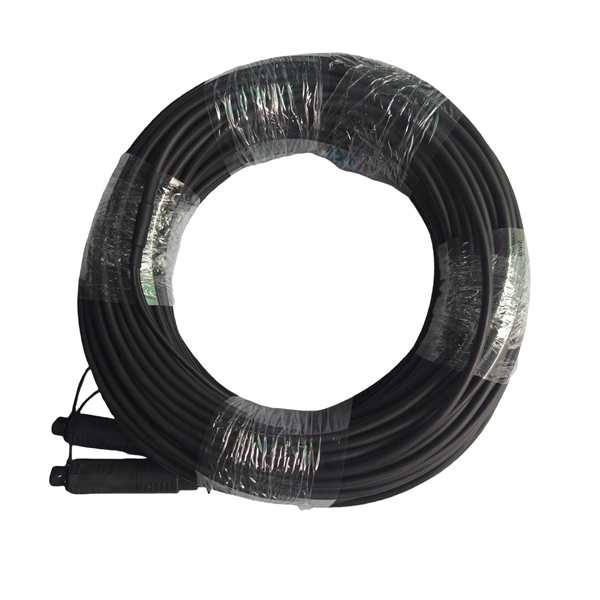
The Power of Fiber Optic Delay Lines in Fiber Optic
In this article, Smart Sci &Tech will introduce the fundamental working principles of fiber optic delay lines, exploring how they function and
Fiber-optic sensor
A fiber-optic sensor is a sensor that uses optical fiber either as the sensing element ("intrinsic sensors"), or as a means of relaying signals from a remote sensor to the electronics that process the signals ("extrinsic sensors"). Fibers have many uses in remote sensing. Depending on the application, fiber may be used because of its small size, or because no electrical power is needed at the remote location, or because many sensors can be multiplexed along the length of a fiber by using light wavelength shift for
Optical Delay Lines – variable, scanning, free-space, fiber delay lines
Optical delay lines provide variable time delays for interferometers, autocorrelators, and optical sampling, using free-space optics or fiber delay lines.
Fiber-Optic Temperature Sensor Using Differential LP-Mode Delay
Abstract: In recent years, different kinds of fiber-optic temperature sensors have been widely applied in various areas such as power systems and environmental monitoring, which are
Fiber Optic Sensors: Types, Working Principle
Explore fiber optic sensors: their working principles, types (intrinsic, extrinsic, hybrid), and diverse applications in mechanical, chemical, and structural health
How Are Fiber Delay Lines Used in Fiber Optic Sensors?
Fiber optic sensors have emerged as a powerful technology with numerous advantages, including immunity to electromagnetic interference, small
(PDF) Optical Fiber Sensors: Working Principle
However, sensors based on fiber‐optics have been developed rapidly because of their excellent sensing performances and capability to function in
CHAPTER 09 FIBER OPTIC SENSORS
communication system via using fiber optics there was a great demand to measure and sense the rate of data transmission, change in phase, intensity, and wavelength and in the case of incentive
Fiber Optic Sensors: Fundamentals, Principles & Applications
Extrinsic Fiber Optic Sensors Fiber is Only an Information Carrier To and From a Black Box Light Signal Generation in Black Box Depending on the Arriving Information
CSM_FiberSensor_TG_E_2_1
Optical fiber is comprised of a central core with a high refractive index surrounded by cladding with a low refractive index. When light enters the core, repetitive total internal reflection at the boundary of the
Microsoft Word
Abstract—The fiber-optic gyroscope is an angular rate sensor. The output delay time of the fiber-optic gyroscope determines the tracking accuracy of the angular rate, and it also affects the
Optical Fiber Sensors Guide
Introduction The field of fiber optics has undergone tremendous growth and advancement over the last 25 years. Initially conceived as a medium to carry light and images for medical endoscopic
Fiber Optic Sensing: A Beginner''s Guide
Fiber optic sensing relies on light rays within optical fibers to detect changes in temperature, strain, and other environmental parameters. Utilizing
Fiber Loop Ringdown — a Time-Domain Sensing
Fiber loop ringdown (FLRD) utilizes an inexpensive telecommunications light source, a photodiode, and a section of single-mode
Fiber Optic Sensor Principles | How Fotonic Sensors
Learn how MTI''s Fotonic fiber optic sensors measure displacement, vibration, and surface conditions using reflected light. Explore probe configurations, response
Disturbance Detection in Distributed Fiber-Optic Sensor
A novel double Sagnac distributed fiber-optic sensor based on Sagnac interferometer for determining the position of disturbance along an optical fiber is presented.
Fiber Optic Sensor | Precision, Speed & Electrodynamics
Fiber optic sensors are broadly categorized into intrinsic and extrinsic types. Intrinsic sensors integrate the sensing function within the fiber,
Introduction to Fiber Optic Sensors and their Types
Article provides diffrent types of FIber optic sensors andvapplications is a sensor that uses optical fibers for sensing the elemnet (remote sensing).
Related Video Reference
This video was associated with the source search result. Verify technical details against current product documentation and project requirements.